
May
Hi friends! Ever since I first released my Amigurumi for Beginners video, I’ve been receiving messages from people who are new to crochet asking me what they should be using.
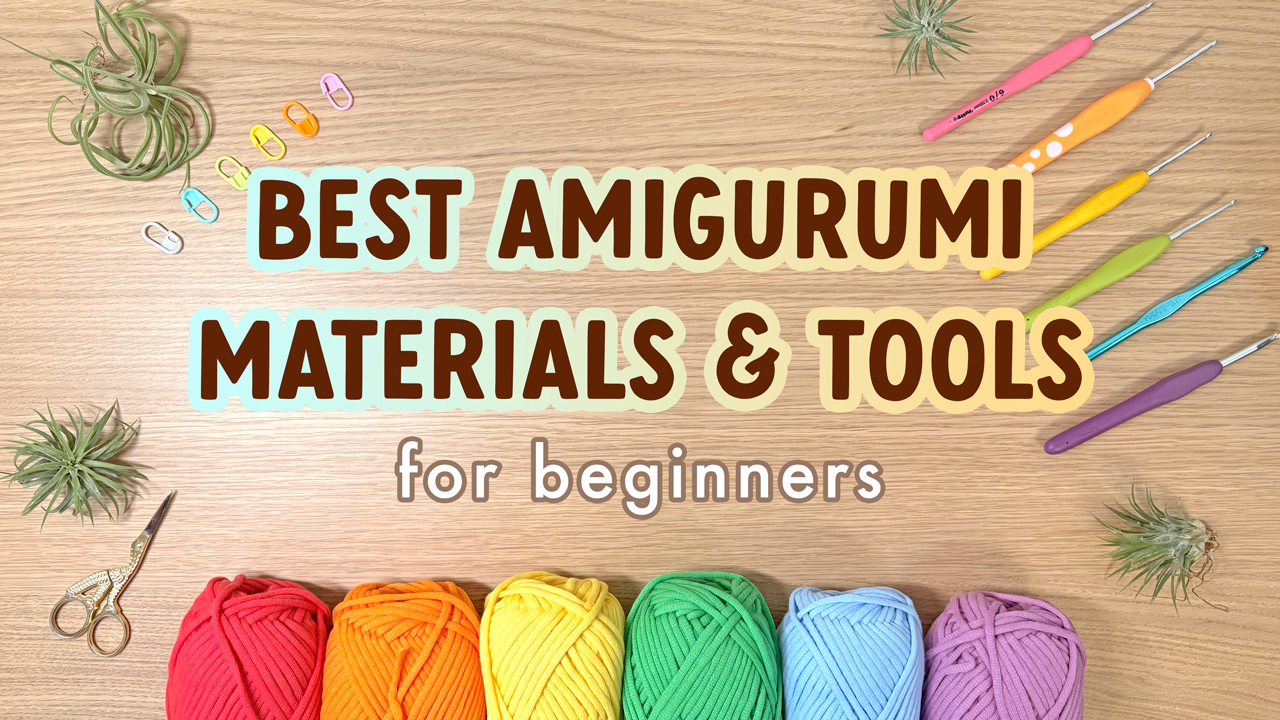
After years of trying different yarns and tools out, I finally came up with a list of items that I think amigurumi beginners should own. For a lot of beginners, shopping for yarn and crochet tools can be very intimidating. Craft stores have aisles upon aisles of different types of yarns to choose from, and ordering online can also be quite confusing if you don’t know what you’re looking for. Which is why I wanted to come on here to give you a quick guide for what to look for when shopping for amigurumi materials and tools.
I go into a little bit more detail of why I am suggesting certain tools and materials in my latest YouTube video, and you can watch that here if you are interested:
This post contains affiliate links to different products. This means that, at no additional cost to you, I will earn a commission if you click through and make a purchase through my links. You can read more about it here.
Crochet Hook
The first tool you will need when learning to make amigurumi is a crochet hook.
If you are new to amigurumi, I recommend you get one of these sets that have a few different sizes of ergonomic hooks.

When learning to make amigurumi, it’s usually a little bit easier to use a slightly larger hook than what the pattern suggests.
Most amigurumi patterns out there will recommend you use a smaller hook to ensure that the stitches are tight and the stuffing doesn’t show through, but starting out with a smaller hook when learning to crochet makes it slightly more difficult to learn. When using a smaller hook, your stitches are going to be tighter and it’s more difficult to insert your hook into tighter stitches, especially when you’re still learning how to hold your hook.
That’s why I think it’s a good idea to get a set that has multiple hook sizes so that you can size up slightly to learn, then eventually size down for a cleaner looking toy once you get more comfortable with crocheting. It’s also just nice to have the different hook sizes because it gives you more options, allowing you to use different weight yarns or create more than just amigurumi.
The set that I own is from WeCrochet, and you’ll be able to find it on crochet.com (costs about $30USD).

This set comes with 15 different hook sizes, so you’ll be covered for any type of crochet projects you may come across. The different coloured ergonomic handles are also comfortable to hold and makes it easier to identify sizes by sight.
If you are on a tighter budget, Amazon also sells sets of hooks that include a few other added accessories (darning needles, stitch markers, etc) at a more affordable price point (between $8-17USD, depending on the set you get), and I think those sets are great as well.


The smaller hooks in these sets are usually not in the US hook sizes. So that’s for both the WeCrochet and the Amazon sets. if you encounter a US size hook in a pattern, simply round up to the closest size. So for example, if a pattern recommends a US size B hook (2.25mm), which doesn’t usually come in one of these sets; simply size up and use the 2.5mm crochet hook.
Stitch Markers
Locking stitch markers are little unassuming clips that are really handy when making amigurumi. They are great to help you keep track of where you are in your project, and if you’re making larger amigurumi toys, you can also mark your stitches in different increments to make counting a little easier.
I think it’s a great tool for beginners because it saves you from having to count your stitches and rounds over and over. And speaking from experience, I had no idea how to count my rounds when I first started, so it’s nice to have a marker that makes it easier to keep track of where you are.
I get mine from a variety of sources, but they’re all very similar. I’ll link a few below.

WeCrochet – this is a good add-on if you are trying to get free shipping on WeCrochet (they have beautiful yarn and tools!).

Amazon – very affordable and you get a lot. They also come in more colours.
Darning Needles
The next tools I think beginners should get are metal darning needles of different sizes.

When shopping for tapestry or darning needles, you’ll often see thick plastic or metal needles that are sometimes advertised as “yarn needles”. And these are completely fine if you are using thicker yarn, but if you are using worsted weight or thinner yarn, the thicker needles are going to be tricky to sew with.
With how tight the stitches are supposed to be for amigurumi, you’ll have a much easier time sewing with a thinner metal needle.
Clover has a really great set that includes these three darning needles and I think that this set is good enough for most amigurumi projects.

The large needle is good for thicker yarn and non-amigurumi projects like wearables. The medium one is great for sewing amigurumi parts together when using worsted weight or thinner yarn. And the small one is great for embroidering details onto your amigurumi or sewing smaller parts.
You’ll be able to find the Clover set at most craft stores, but I’ll link a few below.
The hook set that I mentioned from Amazon earlier also includes a few metal darning needles in various sizes so you don’t have to purchase them separately if you buy a set like that.
Sewing Pins
Sewing pins are a great tool to have on hand if you are doing any type of amigurumi that requires sewing. They help keep the pieces in place while you are sewing the parts together and can make a world of difference in your finished project.
You can use sewing pins of any kind, and I find that it’s nice to have a variety of sizes for your pins. The smaller ones are great for tighter spots but thicker, stiffer ones are great for anchoring a piece down.

Polyester Fibrefill Stuffing
To make amigurumi, you’re also going to need to buy some polyester fiberfill stuffing. The most common brand in North America is Poly-fil and you’ll be able to find this at most craft stores and even Walmart.
For beginners, I would suggest you start with the smallest bag available. With polyfil, a little goes a long way as it does fluff up more once you open the bag.

It’s usually cheaper if you purchase directly in store, but I’ll put a few links below if you are having trouble sourcing it locally.
Saftey Eyes
For beginners who want to use safety eyes, I suggest you get one of these sets that have a few different sizes instead of a big pack of the same sized eyes.

Getting these sets that have a variety of eye sizes will give you more flexibility in the types of projects that you get to make. I purchased one of these sets when I first started, and from that set, I learned that I prefer 6mm and 8mm eyes. Once I used up those sizes in my first set, I purchased a big pack of the same size eyes.
Just make sure that when you’re shopping for these, you’re getting the safety eyes that have a washer backing that snaps in for more security.
There are lots of different types of safety eyes out there, and here are a few of my favourites:
Black Round Safety Eyes

Oval Kawaii Safety Eyes

Best Yarn for Beginners
One of the most beginner-friendly types of yarn out there is called “tubular yarn”. This type of yarn usually has a polyester filling in the center and a machine knitted casing that covers up that plushie center.

Tubular yarn is great for beginners because it doesn’t split and the casing outside helps to make it a smoother crocheting experience. A lot of the times when crocheting with materials like acrylic or cotton, you’ll notice that the yarn splits sometimes and a few of the strands get left behind, leaving you a messy looking stitch that you then have to redo.
With tubular yarn, that’s not likely to happen. It’s also not fuzzy so you can see the stitches very clearly and know exactly where to insert your hook. This is why tubular yarn is such a great option for beginners because you can learn what stitches look like and have an easier crochet experience.
The most accessible one to me is the Yarnspirations Bernat Maker yarn.

Each skein weighs 250g and it costs $12.99 USD. So it’s not super cheap, but you do get a really big skein of yarn. This yarn is very similar in terms of thickness and texture to the Woobles Easy Peasy Yarn, but with the Bernat Maker, you actually get 40% more yarn for the same price.
Yarnspirations also has a set of 10 mini skeins of the Bernat Maker yarn in a bunch of fun colours. And I think this set is really great for amigurumi because you get all these fun colours instead of one big skein of one colour.

For this yarn in particular, I recommend beginners try it out with a 4.5mm crochet hook. This is a good hook size to start with, but you can always go down or up a hook size to adjust to your needs. And if you’re using different weight yarn, an easy way to figure out what hook size you should be using when making amigurumi is to match the thickness of your hook to the thickness of your yarn.
Yarns to Avoid as a Beginner
Before I end the post, here are a few things to avoid when shopping for yarn as a beginner:
- Darker coloured yarns – It’s quite hard to see your stitches when using darker coloured yarns, which will make it more frustrating to crochet with.
- Fuzzy textured yarns – fuzzy yarns like faux fur yarn, chenille, and fuzzier acrylics can be more difficult to work with because you can’t see your stitches clearly.
- Loosely textured yarns – avoid yarns like 100% cotton or certain acrylic yarns. Because the strands that make up the yarn are so loosely twisted, it’s actually a lot easier to poke through the yarn with your hook, and this could lead to really messy looking stitches.
- Fragile yarn – A lot of chenille yarns have a really fragile centre strand and can break with just a pull. This makes it more difficult to do the magic circle because the yarn will snap when you try to close your magic circle. There are ways to work around this, but it can just be a little too frustrating to work with for beginners.
- Yarn that is too thin or too thick – For beginners who are just learning how to hold their hook and yarn, yarn that is too thin or too thick can be a little difficult to hold. Personally, I think anything in the medium/bulky weight categories are great for beginners.
These are all the tools and materials that I recommend for beginners and I hope you found this post helpful! If you’re new to amigurumi, you’ll find a bunch of beginner-friendly tutorials on my YouTube channel. I also have a lot of free patterns on my blog!
Thanks for stopping by and reading through this post! Happy crocheting!

